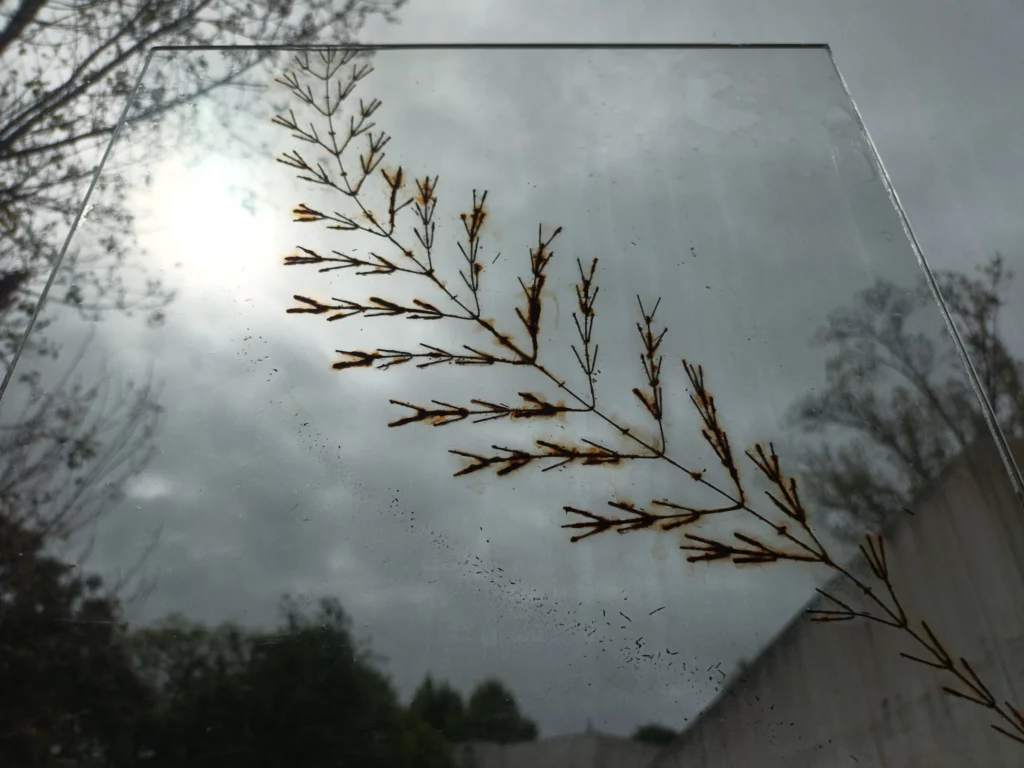
Figure 1 Untitled, 2021, digital photograph. The image details oxidised steel wire mesh that has been trapped between two sheets of transparent glass at temperatures above 600° C. The manipulated steel and glass panels were photographed leaning against a normal window. The oxidation and corrosion of the object within the photograph have not stopped. Thus, transformation within the “real object” means that the photograph, in its digital state, remains the most fixed material within this equation.
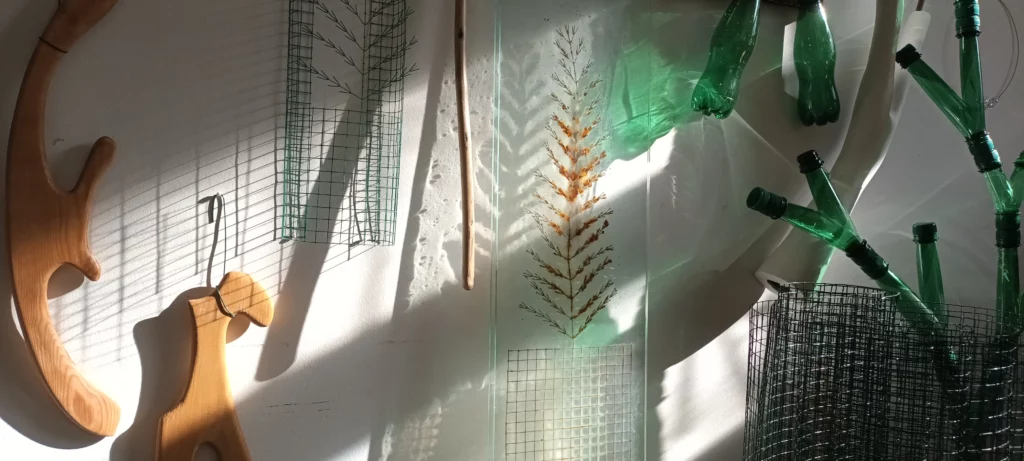
Figure 2 Untitled, 2023, digital photograph. The image shows light passing through and hitting against various materials in the studio. Glass, plastic, wood, and steel wire mesh, along with light and shadow make up the materials captured in the photograph. Upon careful consideration, it becomes clear that any solid ideas of materiality dissolve into less tangible ones within the image.
Dialogues
[Leonel]
This is Leonel from MATERIA team. Firstly, we’d like to thank you for your contribution to the MATERIA critical lexicon.
It wasn’t clear to us which concept you were proposing as an entry in the lexicon. As we have given collaborators the freedom to change the concepts from the labs, we would ask you to confirm your entry in the lexicon, i.e. which concept you intend to problematise from the photos.
We don’t yet know how we’re going to make the interactions between the different contributors to the lexicon, but we’d like to establish some dialogues and joint reflections. That’s why I’m taking the liberty of sharing with you the thoughts I had when I saw your contributions. My intention is not to supplement the information you send, but to try to start a dialogue that can then be extended to other people. Here goes:
Figure 1: Even though photography, in its digital state, remains the most fixed material within this equation, the physical support of digital information is also subject to transformation processes that will eventually result in the degradation of the information. It’s interesting to realize that because of the different transformation processes to which the real object and its digital representation are subject, they will become more distant from each other and from the original object as they evolve over time. As a result, I wonder if we can say that, strictly speaking, photography is never a ‘real’ representation of the object because by the time the information is recorded and visualised, the object has already moved away from its original state, albeit subtly, testifying the transformative nature of matter, which is impossible to arrest.
Figure 2: Your contribution made me realize how interesting photography is as a way to reflect about matter, because not only does photography dissolve solid concepts of materiality, but it also materialises what is not by fixing a non material entity (light) as digital information on a material electronic support. In this sense, photography highlights the relationship between the material and the non-material, fixing information about the material world through a process of dematerialisation and subsequent rematerialisation on a different medium. In the photograph light becomes materialised as objects lose their solidity.
Maybe my reflections are too flat and don’t add much to the discussion, but I thought it made sense to share them anyway.
Cheers!
[Robert]
Hi Leonel,
Thanks for your message, and especially for your comments. If these images of material and immaterial “things” can help instigate thoughts on the theoretical nature of photography, the implications of capture, preservation, and change, or otherwise lead to a struggle to define connections to ideas of an academic nature, then they are functioning as hoped. However, I will also admit that your challenge in understanding which concept(s) from the Material-Materiality lexicon are of my concern likely owe to the fact that I also do not know. That is to say that I selected these images precisely because of their qualities of being at once things, and not things.
As I see it, our attempts at creating a critical lexicon surrounding ideas of material, materiality, and related “materials” ultimately and always run up against the physical and philosophical limits that our reality entails. What I mean is that our attempts at discursively describing a universe in the constant change you mention will always miss the mark. We do not even need to introduce the gravity and quantum issue. For me, a New Materiality seems an attempt at Monism, but the relational nature of words themselves, acting as ratios that describe this and that as distinct entities, eventually collapses into contradiction. Well, that is my opinion and is significantly more challenging to untangle that I am capable of today. What I mean here is that the images, and the works of art, have existences in flux that do not require the specificity of what we hope to describe with concepts.
The art can exist in simultaneity, being at once known and unknown, and not suffering from the indistinction, but instead, potentially instigate, illustrate, or otherwise point us toward both the specific and the ambiguous. Like light, or other particle-wave entities in our physical world, I see the images as potential problems and solutions at the same time. As an artist working within academia, this problem is of central concern. My art making does not require discourse or concept in order to come into existence, and still comes into existence within discourses and surrounded by conceptual implications. My creative work, as I understand it as the author, whether considered through the digital image, through the nature of my material choices, or at the intersections of art and science, is liminal. Its material and materiality are not immutable. My idea is that our critical lexicon is itself problematized by these images. Words are energy that vibrate material, but I think that we can attribute materiality to them only in a philosophical sense. The images I chose were attempts at instigating broadly.
I am sure that I am just digging a hole for myself with you Leonel. I am sorry about that, but I am honest in my effort. Your hesitation in your reading, suggesting something may be flat, likely comes from the treason of translating our feelings into words. I found what you said to make perfect sense, while still leaving room for other readings of the images. Remember, I am an artist, and much like the court jester or perhaps the alchemist, I find my work to be in joining things in silly ways, and watching the distillation, putrefaction, transformation, or explosion. To be able to succinctly and objectively name is not one of my talents. I really only give questions…no answers. However, if anything I have said here leaves you wanting clarification, I am happy to try. I can usually find focus on a lens…perhaps eventually I can get there with words too.
Warm regards from the coast, Robert
[Leonel]
Dear Robert,
In no way has your reflection created a hole between our understanding. What you say is an important critical reflection on the very concept of a lexicon for materiality. We’ll find a way to include your entry without the need to limit it into a single concept.
As you know, I used to be a chemist and there was a time when I became interested in the history of chemistry and alchemy and I found it very curious that the alchemists saw the process of distilling an impure liquid as the equivalent, in the material world, of Christ’s spiritual experience. The very shape of the alchemist’s retort resembled that of the pelican that sticks the beak into its chest to feed its young with blood, also a symbolic representation of Christ’s sacrifice. And we’re back again to the duality of matter/spirit, not necessarily understood as two separate realities, but rather two manifestations of the same reality, a bit like wave-particle behaviour on the quantum scale.
Thank you for your reflections, which may be interesting to add to the dialogues that will accompany the lexicon.